
AI adoption in CBSE schools is no longer a future conversation; it is already becoming a present-day reality across Indian education.
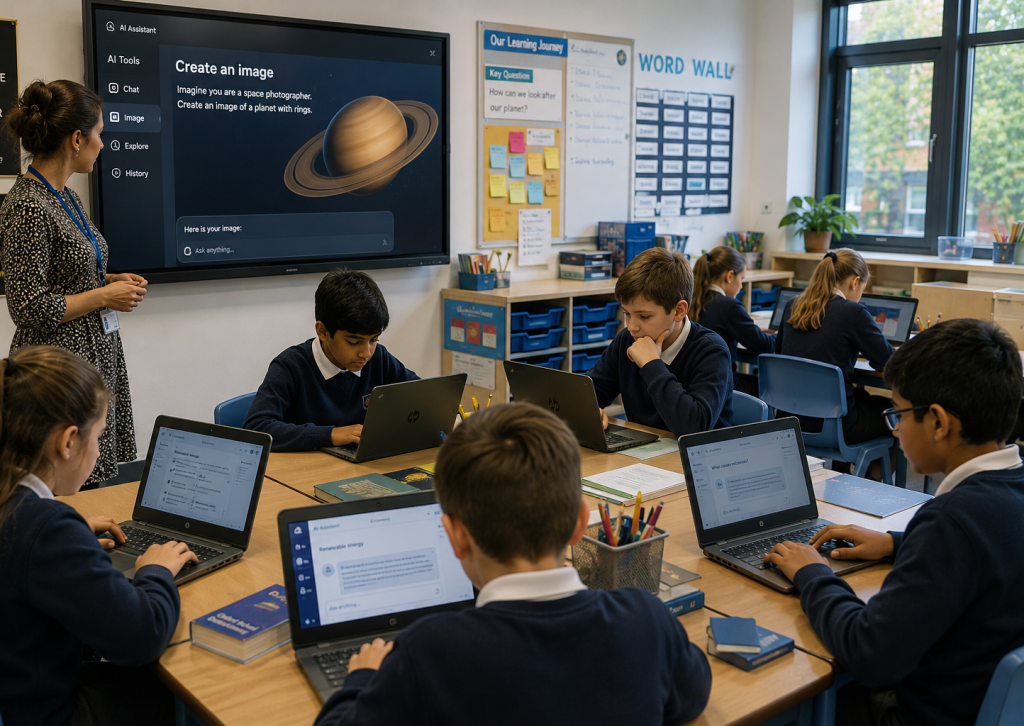
Artificial Intelligence is rapidly entering classrooms, assessments, lesson planning discussions, and teacher training programmes across India. Schools are increasingly being encouraged to prepare students for a future shaped by automation, data, and intelligent technologies, and Central Board of Secondary Education has made that direction very clear.
Through its AI curriculum and AI integration framework, CBSE is encouraging schools to move beyond traditional teaching models and begin building AI readiness in schools through interdisciplinary learning, experiential pedagogy, and technology-supported classrooms. On paper, the vision is progressive.
But inside many schools, the reality is more complicated.
Because while policy conversations around AI are moving quickly, implementation on the ground is still uneven. And that gap is quietly becoming one of the biggest challenges of AI adoption in CBSE schools today.
What Is CBSE’s AI Framework Actually Trying to Achieve?
CBSE’s approach to AI is far more ambitious than simply introducing coding or robotics into schools.
The framework positions Artificial Intelligence as both a subject and a teaching approach. Instead of treating AI as an isolated discipline, schools are being encouraged to integrate AI concepts across subjects like Mathematics, Science, English, and Social Science.
The larger goal is to create students who can think critically, solve problems, analyse data, and understand how technology impacts the real world.
This is a major shift from traditional classroom models focused heavily on memorisation and standardised outcomes. CBSE’s framework also emphasises project-based learning, AI ethics, data literacy, and experiential classroom activities. Teacher training has been identified as a central part of this transformation because meaningful AI integrated learning cannot happen without educator participation.
The conversation is no longer: “Should schools teach AI?”
The real question now is: “How schools are implementing AI meaningfully.”
Why is AI adoption in CBSE schools becoming important?
The Real Problem Is Not Technology. It Is AI Readiness.
Most schools today understand that AI matters. The challenge is whether schools are operationally prepared to integrate it effectively.
In many institutions, AI adoption still happens in fragmented ways. Some schools conduct isolated AI workshops without long-term implementation plans. Others introduce smart classroom tools without redesigning classroom workflows or assessment strategies. In some cases, individual teachers experiment with AI independently while the larger institution still lacks clear digital policies.
This creates a visible disconnect. Schools want to appear innovative, but many are still building consistency in teacher training, classroom implementation, and digital systems. That is why AI readiness in schools cannot simply mean purchasing software or launching an AI club.
Real readiness requires schools to rethink how learning, teaching, assessment, and technology work together.
Teachers Are Being Asked to Adapt Faster Than Ever
One of the strongest observations in CBSE’s AI framework is its focus on teachers. The document repeatedly highlights that successful AI-integrated learning depends heavily on teacher familiarity, classroom experimentation, and interdisciplinary collaboration.
But this transition is not always easy. Teachers today are navigating changing classroom expectations, AI-generated assignments, unfamiliar digital tools, and growing pressure to modernise learning experiences quickly.
This is where conversations around teachers and AI tools in classroom environments become critical. The issue is not resistance.
In most schools, teachers are willing to adapt and learn. The bigger challenge is whether schools are creating enough structured support around them. Without proper implementation planning, AI adoption often becomes inconsistent across departments and classrooms.
And when implementation becomes inconsistent, the learning experience becomes uneven for students as well.
What are the biggest challenges of AI in schools?
AI Adoption Without Assessment Change Creates New Problems
One of the biggest gaps in AI adoption in CBSE schools is assessment design.
If students can now generate responses using AI tools, traditional recall-based assignments become far less effective than before. Schools can no longer rely entirely on memorisation-driven assessments while simultaneously encouraging technology integration. This means schools must begin redesigning how they evaluate learning.
The focus now needs to move towards interpretation, creativity, collaboration, application, and higher-order thinking rather than simple information recall.
Interestingly, CBSE’s framework already hints at this shift by emphasising experiential learning, problem-solving, and AI ethics within classroom pedagogy.
But changing assessment systems across schools is a far more difficult process than introducing new tools.
And this is exactly where the gap between policy and practice becomes most visible.
AI Integration Is a Pedagogy Shift, Not Just a Technology Upgrade
Many schools still approach AI adoption as a technology initiative.
But AI-integrated learning is actually a pedagogy shift. CBSE’s “AI+X” approach encourages schools to connect AI concepts with regular classroom subjects instead of isolating them into one specialised area.
For example, students may use AI tools in Mathematics data analysis, explore Natural Language Processing activities in English classrooms, or apply Computer Vision concepts during Science projects. This changes the role of AI completely.
Instead of becoming “another subject,” AI becomes part of how students analyse information, solve problems, and interact with the world around them.
That requires far more than software subscriptions. It requires curriculum alignment, teacher confidence, interdisciplinary collaboration, and long-term digital planning.
How schools are implementing AI today?
The Schools That Will Lead AI Adoption
The schools that succeed with AI adoption will likely not be the schools using the most AI tools. They will be the schools creating the clearest systems around them.
That includes stronger teacher enablement, responsible AI usage policies, balanced digital workflows, ethical classroom practices, and assessment models designed for critical thinking.
Because meaningful AI readiness in schools is ultimately not about automation alone.
It is about preparing students to think critically, adapt responsibly, and function intelligently in a rapidly changing world.
CBSE’s AI initiatives represent an important shift in Indian education. The intent is ambitious, necessary, and future-focused.
But successful AI adoption in CBSE schools will depend less on how quickly schools adopt technology and more on how thoughtfully they integrate it into teaching, learning, and school operations.
The real challenge is no longer introducing AI into schools.
It is building classrooms, teachers, systems, and assessment models that are genuinely ready for it.
And that difference will define which schools simply follow the AI conversation and which schools truly lead it.